 Paradox of Choice
The Paradox of Choice
“Choice Within Constraints, Freedom Within Limits” — Barry Schwartz
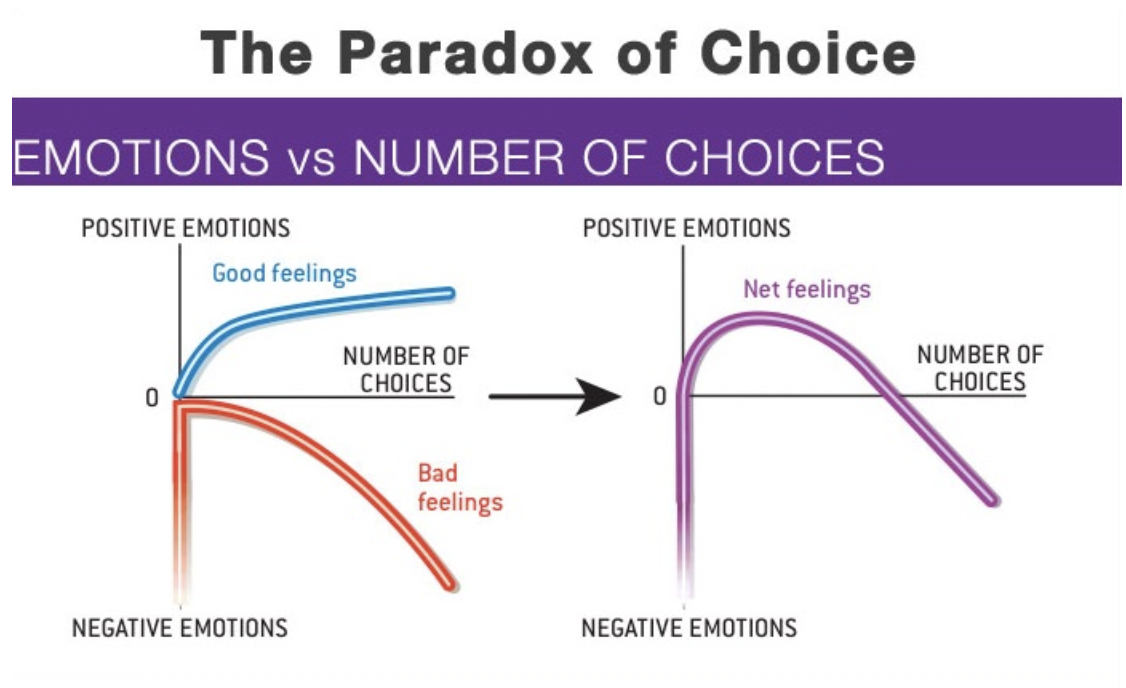
America values freedom and choice, and in recent years, this emphasis means the number of choices available to us is ever increasing. The same explosion of choice is true in other aspects of our life — health care, career choices, identity, romantic relationships. All these questions are consuming questions. Often, our society shifts the decision and the responsibility from those who have the expertise and the know-how to us as individuals. We are bombarded with choice every single day. The deluge of choice, in fact, has a cost. The abundance of choice creates two effects.
Choice Paralysis
It produces paralysis rather than liberation — with so many options to choose from, people find it hard to choose at all.
Less Satisfaction
We end up less satisfied than when the choices are more limited:
- Regret and anticipated regrets: the regrets from the “what ifs” of other options decrease our satisfaction with the choice that we made. It’s even more insidious that we have to deal with anticipated regrets; the only way to deal with anticipated regrets is to not make any decision, even when a decision is good for us.
- Opportunity costs: subtract the satisfaction we derived from the choice.
- Escalation of Expectations: Adding more options to people’s lives raises people’s expectations, and it makes it harder for us to be satisfied.
- Self-blame: We blame ourselves for not making the “best” choice.
How to Combat The Paradox of Choice
1. Choose When to Choose
According to Schwartz, one way to combat the paradox of choice is to be selective about what needs to go through a careful decision-making process — “Decide which choices in our lives really matter and focus our time and energy there”.
To put this into practice, try the following: (a) Review some recent decisions you’ve made, both large and small (a clothing purchase, a vacation destination, a job or relationship change); (b) itemize the time, research and anxiety that went into those decisions; (c) reflect on how it felt to do that work; and (d) ask yourself how much your final decision benefited from that work.
“This exercise may help you better appreciate the costs associated with the decisions you make, which may lead you to give up some decisions altogether or at least to establish rules of thumb for yourself about how many options to consider, or how much time and energy to invest in choosing,” writes Schwartz. “For example, you could make it a rule to visit no more than two stores when shopping for clothing or to consider no more than two locations when planning a vacation.”
2. Be a Chooser, Not a Picker
Avoid being a picker, a relatively passive person who simply picks a decision. Choosers have time to modify their goals; pickers do not. Choosers can avoid following the herd; pickers cannot. Making good choices requires time and attention, and it requires rules, norms, and routines. As you review the choices you recently made, you will realize the true cost of choices. In the end, you should strive to:
- Shorten the decision and the time it requires to make decisions that you don’t really care deeply about
- Use some of the time you freed up to ask yourself which areas in life really matter to you
- And if you don’t find that the available options meet your needs, start to think about how you can create more options for yourself
3. Satisfice More, Maximize Less
There are two types of decision makers, says Schwartz: maximizers and satisficers. The difference between the two is their goal when making a choice.
- Maximizers: seek and accept only the best. Maximizers need to be assured that every purchase or decision was the best that could be made. Maximizers are in general more pessimistic, anxious, stressed, worried, tired, overwhelmed, depressed, regretful, and disappointed — and less content, optimistic, elated, excited, and happy.
- Satisficers: will pick something that is good enough and not worry about the possibility that there might be something better. Being a satisficer doesn’t mean you have to sacrifice your standards, however. A satisficer maintains rigorous decision-making criteria, but she is aware that nothing can ever be perfect. “She searches until she finds an item that meets those standards, and at that point, she stops,” writes Schwartz. She is not resigned or settling, he emphasizes; she is “content with the merely excellent as opposed to the absolute best.”
The key to experiencing more satisfaction and abundance, according to Schwartz, is to be a satisficer. The goal of maximizing, he asserts, “can make people miserable — especially in a world that insists on providing an overwhelming number of choices, both trivial and not so trivial.”
“The truth is that maximizing and satisficing orientations tend to be ‘domain specific,’” writes Schwartz. “Nobody is a maximizer in every decision, and probably everybody is in some.” The good news here is that because you already know how to look for “good enough” in some areas, you can teach yourself to seek it out in many of the rest. In areas where you feel compelled to seek out the absolute-best option, remind yourself that no option is ever perfect — and that, paradoxically, the good-enough choice will bring you more of the feelings of abundance you’re searching for in the first place.
4. Think about the Opportunity Cost of Opportunity Cost
The more we think about opportunity cost, the less we will feel satisfied with the choice we made. Be aware of the fact that the opportunity cost subtracts the satisfaction we derived from the choice we make. Some strategies to avoid the opportunity cost of opportunity cost:
- Unless you are truly dissatisfied, stick with what you usually buy
- Don’t be tempted by shiny new toys
- Don’t scratch unless there’s an itch
- Don’t worry that you will miss out on all the new opportunities
5. Make Your Decisions Non-Reversible
Almost everyone prefers having options, but the availability of an option that allows us to reverse our decision actually increases the chance that we reverse the decision, and the process is agonizing. For example, by thinking about marriage as non-reversible, we spend more effort trying to do the best that we can with the life partner that we committed to. Being able to commit to what we decided on rather than constantly second-guessing is much better.
6. Practice Gratitude
Feeling happy and grateful about the good elements of a particular choice, as opposed to feeling disappointed by what is bad about it, can vastly improve our subjective experience, notes Schwartz. But habits of thought die hard, so he advises adopting a simple routine: “Keep a notepad at your bedside. Every morning, when you wake up, or every night, when you go to bed, use the notepad to list five things that happened the day before that you’re grateful for. You will probably feel a little silly and even self-conscious when you start doing this. But if you keep it up, you will find that it gets easier and easier.” Eventually “you may find yourself feeling better and better about your life as it is, and less and less driven to find the ‘new and improved’ products and activities that will enhance it.”
7. Regret Less
We should make an effort to regret less. Some strategies:
- Adopt the strategy of a satisficer instead of a maximizer
- Reduce the number of options before we make decisions
- Practice gratitude in what’s good in the decision, rather than what could have been and what’s bad in the current decision
8. Anticipate Adaptation
We adapt to everything, and this is true whether for good things or bad things. When we are experiencing something great, keep in mind that in steady state it will not be as good as it feels now. Be aware of the hedonic treadmill & expectation treadmill. Similarly, when we are experiencing disappointment, know that things will trend back to the mean experience, and it will not be as bad as it seems now.
9. Control Expectation
We should avoid setting high expectations, and aim for low expectations. This is hard to do.
10. Curtail Social Comparison
Some degree of social comparison is inevitable, but when we use social comparison as a gauge of self-worth, we run into trouble. One top strategy for reducing social comparison, says Schwartz, is to focus on what makes you genuinely happy and what brings meaning to your life. When you keep in mind what really matters, maximizing — and striving to impress the neighbors — seems way less important.
11. Learn to Embrace Constraints
By following rules, we can free ourselves from all kinds of inconsequential decisions. Many of the daily hassles will disappear. There’s the famous research from Harvard that studied what makes us happy; the conclusion was “close relations”. The interesting thing is, close relations constrain rather than liberate us. When you are constrained, you are not faced with an infinite number of choices, and you are protected from the paradox of choice.
Additional talk: YouTube video.