 Grit
Grit
What Grit Is And Why It Matters
Definition of Grit
Grit involves passion and perseverance:
- Passion: Degree to which one works with a distant object in view. Active preparation for later life. Working toward a definite goal. Tendency not to abandon tasks from mere changeability. Not seeking something fresh because of novelty. Not “looking for change”.
- Perseverance: Degree of strength of will. Quiet determination to stick to a course once decided upon. Tendency not to abandon tasks in the face of obstacles. Perseverance, tenacity, doggedness.
Effort Counts Twice
Angela describes doing clever statistical analysis only to be scorned by her advisor for having no theory behind it. After much thought, she arrived at the following formula:
talent × effort = skill
skill  × effort = achievement
Talent is how quickly your skills improve when you invest effort. Achievement is what happens when you take your acquired skills and use them. Angela suggests that skill is not the same thing as achievement. Without effort, your talent is nothing more than your unmet potential. Without effort, your skill is nothing more than what you could have done but didn’t. With effort, talent becomes skill and, at the very same time, effort makes skill productive.
Grit is the key to effort, and gritty people are able to put in the effort to acquire skill, which turns into achievements.
How Gritty Are You?
Angela suggests that gritty people can see their work using a pyramid of goals.
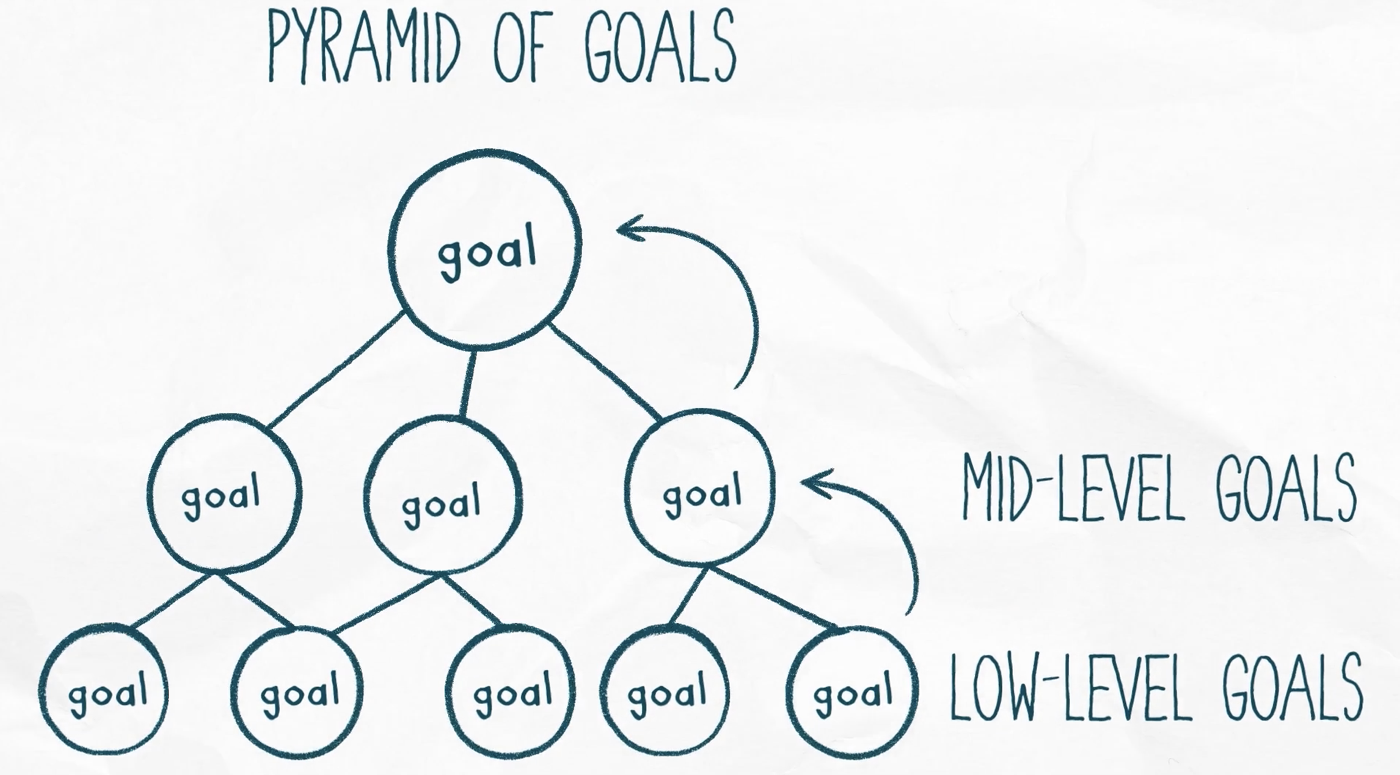
At the bottom of this hierarchy are our most concrete and specific goals — the tasks we have on our short-term to-do list. These low-level goals exist merely as means to ends. We want to accomplish them only because they get us something else we want.
The higher the goal in this hierarchy, the more abstract, general, and important it is. The higher the goal, the more it’s an end in itself, and the less it’s merely a means to an end.
Grit Grows
What the maturity principle comes down to is this:
Over time, we learn life lessons we don’t forget, and we adapt in response to the growing demands of our circumstances. Eventually, new ways of thinking and acting become habitual. There comes a day when we can hardly remember our immature former selves. We’ve adapted, those adaptations have become durable, and finally, our identity — the sort of person we see ourselves to be — has evolved. We’ve matured.
Growing Grit From the Inside Out
Interest
Most grit paragons Angela has interviewed told her that they spent years exploring several different interests, and the one that eventually came to occupy all of their waking thoughts wasn’t recognizably their life’s destiny on first acquaintance. In fact, passion for your work is a little bit of discovery, followed by a lot of development, and then a lifetime of deepening.
Specifically, interests are triggered by interactions with the outside world. The process of interest discovery can be messy, serendipitous, and inefficient. This is because you can’t really predict with certainty what will capture your attention and what won’t. You can’t simply will yourself to like things, either.
Interests thrive when there is a crew of encouraging supporters, including parents, teachers, coaches, and peers. Why are other people so important? For one thing, they provide the ongoing stimulation and information that is essential to actually liking something more and more. Positive feedback makes us feel happy, competent, and secure.
Begin with the answers you’re surest of and build from there. However ill-defined your interests, there are some things you know you’d hate doing for a living, and some things that seem more promising than others. That’s a start.
Don’t be afraid to guess. Like it or not, there’s a certain amount of trial and error inherent in the process of interest discovery. Unlike the answers to a crossword puzzle, there isn’t just one thing that you can do that might develop into a passion. There are many. You don’t have to find the “right” one, or even the “best” one — just a direction that feels good. It can also be difficult to know if something will be a good fit until you try it for a while.
Don’t be afraid to erase an answer that isn’t working out. At some point, you may choose to write your top-level goals in indelible ink, but until you know for sure, work in pencil.
Practice
Each of the basic requirements of deliberate practice is listed below:
- A clearly defined stretch goal
- Full concentration and effort
- Immediate and informative feedback
- Repetition with reflection and refinement
Purpose
Here are three recommendations to foster purpose in what you do:
- Reflect on how the work you’re already doing can make a positive contribution to society.
- Think about how, in small but meaningful ways, you can change your current work to enhance its connection to your core values.
- Find inspiration in a purposeful role model.
Hope
It isn’t suffering that leads to hopelessness. It’s suffering you think you can’t control that leads to hopelessness. Those who think they can’t change tend to assume permanent and pervasive causes are to blame. To foster hope, make sure you can differentiate problems that are temporary (versus permanent) and specific (versus pervasive).
Cognitive Behavioral Therapy — which aims to treat depression and other psychological maladies by helping patients think more objectively and behave in healthier ways — has shown that we can practice interpreting what happens to us and responding as an optimist would. When you keep searching for ways to change your situation for the better, you stand a chance of finding them. When you stop searching, assuming they can’t be found, you guarantee they won’t.
Carol Dweck coined the term growth mindset: the belief that we can change. If you are given the right opportunities and support, and if you try hard enough, and if you believe you can do it, you will get smarter. People with a fixed mindset, on the other hand, react to mistakes as though they’re harmful and problematic.
“We think there is plasticity in that circuitry. If you experience adversity — something pretty potent — that you overcome on your own during your youth, you develop a different way of dealing with adversity later on. It’s important that the adversity be pretty potent. Because these brain areas really have to wire together in some fashion, and that doesn’t happen with just minor inconveniences.”
Collectively, the evidence Angela presented leads to the following story: A fixed mindset about ability leads to pessimistic explanations of adversity, and that, in turn, leads to both giving up on challenges and avoiding them in the first place. In contrast, a growth mindset leads to optimistic ways of explaining adversity, and that, in turn, leads to perseverance and seeking out new challenges that will ultimately make you even stronger.
Growth Mindset → Optimistic Self-Talk → Perseverance over Adversity
Growing Grit From The Outside In
Parenting For Grit
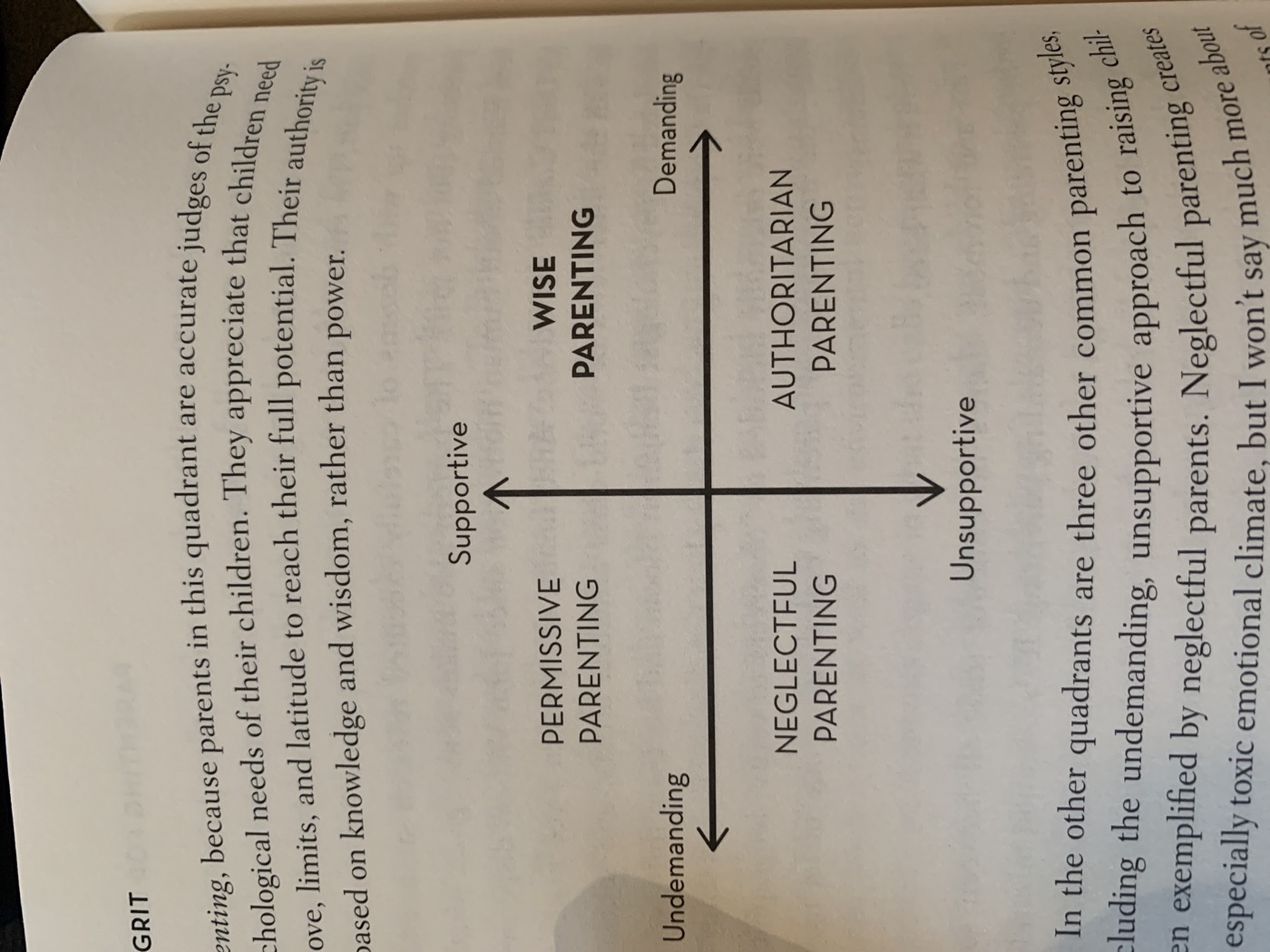
When parenting, you want to be the wise parent, a.k.a. authoritative parenting. If you want to bring forth grit in your child, first ask how much passion and perseverance you have for your own life goals. Then ask yourself how likely it is that your approach to parenting encourages your child to emulate you. If the answer to the first question is “a great deal”, and your answer to the second is “very likely”, you’re already parenting for grit.
Shopify founder Tobi Lütke’s story:
[My mentor] somehow knew the extent of my comfort zone and manufactured situations which were slightly outside it. I overcame them through trial and error, through doing… I succeeded.
The Playing Fields of Grit
As a parent and as a social scientist, Angela recommends that, as soon as your child is old enough, you find something they might enjoy doing outside of class and sign them up. As she puts it: “If I could wave a magic wand, I’d have all the children in the world engage in at least one extracurricular activity of their choice, and as for those in high school, I’d require that they stick with at least one activity for more than a year.”
The key is that these structured activities teach life lessons beyond academics. The child learns from others, finds out through experience what their priorities are, and develops character.
Conclusion
In character building, Angela roughly breaks them down into several categories:
- Intrapersonal: Grit, self-control — these are often related to the performance or self-management aspect of the person.
- Interpersonal: Gratitude, social intelligence, self-control over emotions like anger. These virtues help you get along with and provide assistance to other people.
- Intellectual: Curiosity and zest — these encourage active and open engagement with the world of ideas.