 Designing Your Work Life
Frameworks
Maker’s Mix
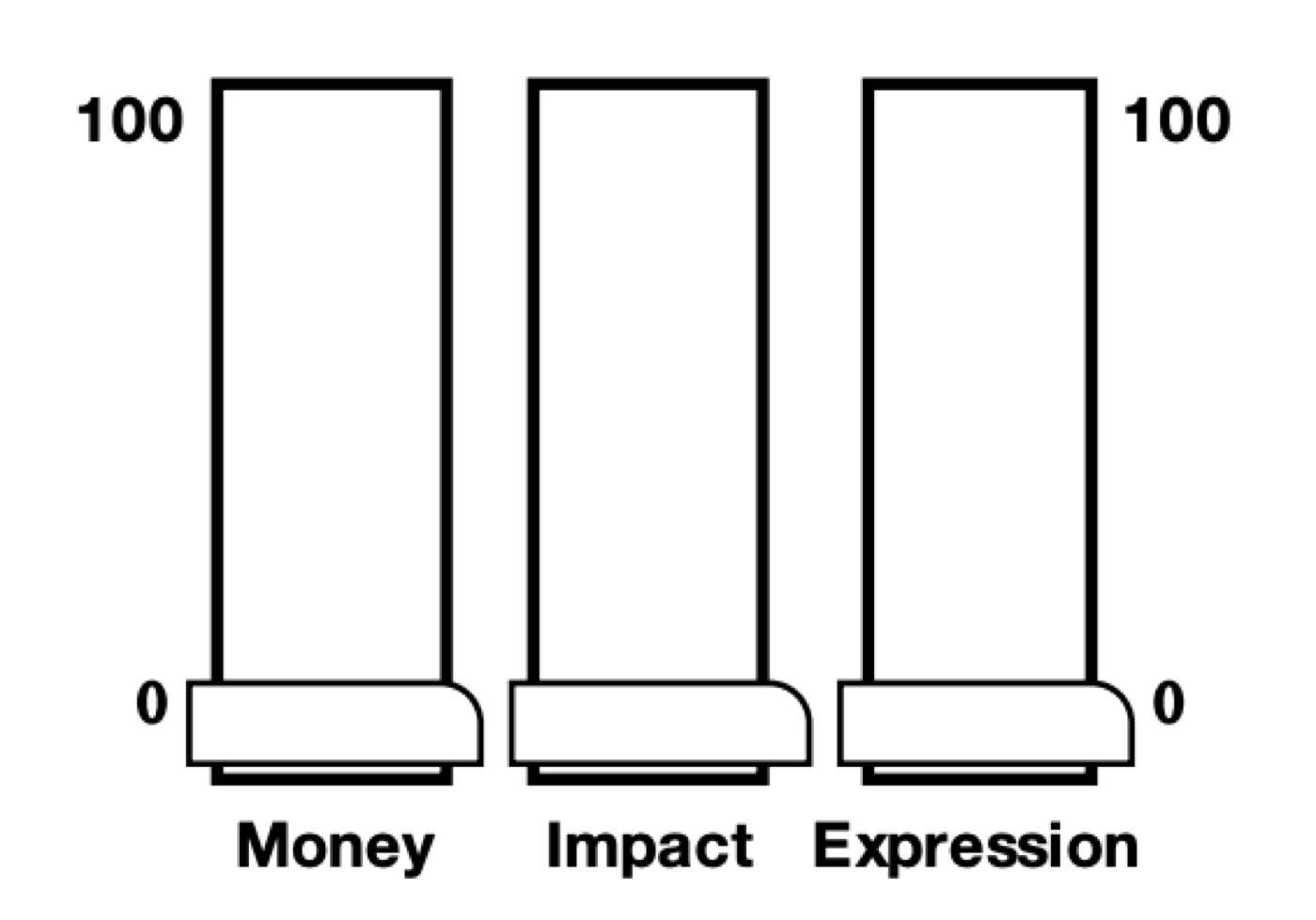
This graphic has sliders for three kinds of “maker outputs” — for the market economy, we will adjust Money in the mix; for the making-a-difference economy, we adjust Impact; and in the creativity economy, we will dial up Expression. The goal is to help you understand where you are today, and where you aspire to be tomorrow. You move the sliders intuitively and keep adjusting the mix of money, impact, and expression until it feels right. There are no units — just a range from 0 to 100.
Impact Map
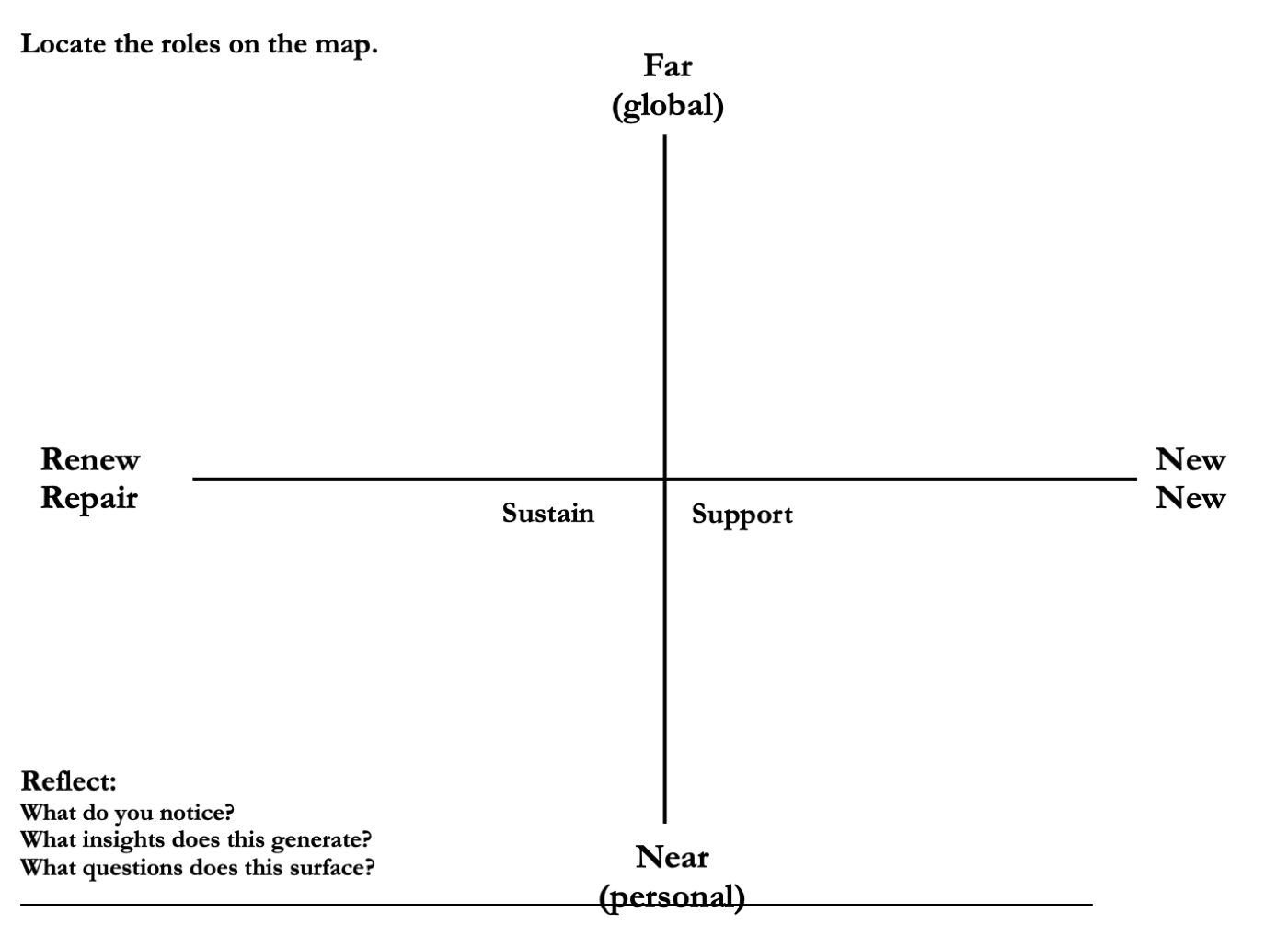
A 2×2 reflection tool for understanding where your work creates value and where you personally draw meaning from it.
- Horizontal Axis: asks who is affected by your work. Near/Personal impact is impact that you can directly see. Far/Global impact reaches beyond your direct environment. Do you feel more energized when impact is visible and close, or when it reaches broadly even if you don’t directly see it?
- Vertical Axis: asks what kind of contribution you are making. Support means you are enabling others to do something, and sustain means directly maintaining or preserving something valuable.
⭐ Don’t Resign, Redesign!
- Reframe and re-enlist: to the job you have by finding a different story for a relationship to your work, crafted by realigning your activities around your organization’s priorities — making you more valuable in the process.
- Remodel: your job through a combination of cosmetic and structural modifications that better align with your interests while utilizing more of your signature strengths, resulting in improved performance that makes your boss happier and improved engagement that makes you happier.
- Relocate: Slide laterally into a new role that’s within reach, even if it’s not obvious at first. Either it’s an existing opening or a new position created just for you.
- Reinvent: Launch a new career. It’s the You 2.0 Program, but at the same company, in a completely different kind of role for which you’ve prepared and retrained to give you a major career refresh and your employer continued access to a loyal and valuable team member.
⭐ Craft Your Ideal Job
This is a structured imagination exercise that will help you to figure out what it will feel like when you quit and help you understand what you like and don’t like about your current job. Beyond that, it may ultimately help you decide if you want to quit or not.
- Imagine that, having exhausted all other possibilities, you are going to quit your job.
- Create a job description that includes everything you do — include the stuff that you are supposed to do and stuff that you actually do. Make it a comprehensive list of all your responsibilities.
- Now review those responsibilities, and see which ones could potentially be delegated to someone else. Cross those out.
- Review the remaining responsibilities, and see which ones you do not enjoy doing. Cross those out, too.
- Review what’s left on your list — the items that are left are the responsibilities and tasks that are part of your job description that you enjoy. This is your core job description.
- Make a list of the new and valuable things you would like to do, if you had the time, training, and support. This is the stuff that would be either helpful to your organization or related to you learning something new, or both.
- Recompile the list — this is your new core job description. It is designed around your current skills and your emerging new interests. It shouldn’t fit the “job” you currently have, it’s the one you want.
- It shouldn’t be a fantasy job description.
- Once you’ve completed this job redesign, wait a day or so and then come back and read it.
- Is it consistent, does it describe a job that makes sense? Could someone with your skills and abilities be expected to be good at this job?
- Now imagine that you are able to find the job you’ve just described. Really imagine it, and inhabit what it feels like to quit your current job for this one. There is no risk, it’s just in your imagination. Then imagine going through the steps you’d have to do to make this new job real.
- List those steps.
Here’s why this imagination exercise works. Adopting the role of the “quitter who moves on to the better job,” even in your imagination, allows you to free yourself from the constraints that control the reality of your current job. These are most likely bogging down your imagination. Imagining quitting and moving opens up your creativity and, assuming you like some of the ideas in your new job description, it suggests prototypes that you could try, even in your current job.
Prototypes like:
- Brainstorming with some of your current colleagues about taking on those responsibilities that you delegated away in this new job description?
- Having a conversation with your boss about the things you do not enjoy doing? Imagine sitting down with him or her and brainstorming about how to increase your efficiency by not doing these things.
- How could you prototype learning some of those new things you want to learn, things that would make you happier and might make your boss happier with you, too?
In the end, by imagining this possible future you will have learned something about how you react, physically and emotionally, to this new job possibility. And you have a chance to experience any regret or second thoughts about leaving the job you have, before you actually do it. You might learn something from that experience, too.
We recommend going through this imaginary redesign before you actually quit. It is a refreshing way to reboot your creativity and redesign whatever you’re doing, without the real world constraining your solution. And you will almost always learn something about yourself.
⭐ Mine Your Network & Build Your Story
Reaching out to your network and engaging in conversations to share your story is a great way to find (hidden) opportunities. To do that, you can do the following exercise to build a narrative.
- Give yourself a long weekend and do something you really like doing to recharge your batteries and get set to start a whole new season of job searching. Get your head wrapped around taking at least 3 and up to 6 to 9 months for this project. Pace yourself — this is not a sprint.
- Make a “Take it with Me” inventory, listing all the assets you’ve gained during your employment in your current work. Don’t forget to list all types of things: learnings, peak experiences, hard challenges, people, relationships, personal growth, accomplishments, future goal clarity, credibility building, etc.
- Read and research and click your way all around your locale and your area of career interest to find out what’s happening, what companies are leading, and who’s doing what.
- Reach out to your network for referrals to “get the story” meetings, prototype conversations about relevant topics that are current in your field and of sincere interest to you. Scan LinkedIn for people you’d like to have coffee with, and do not ask them for a job! They will be blown away that you think they are interesting.
- Start having those conversations and enjoy yourself — make the learning its own game and its own reward.
- Repeat the process.