 Atomic Habits
The major ideas of the book “Atomic Habits” are roughly summarized here. All the relevant materials on habits can be found on his website.
Identity-Based Habits
Summary: The key to building lasting habits is focusing on creating a new identity first. Your current behaviors are simply a reflection of your current identity. What you do now is a mirror image of the type of person you believe that you are (either consciously or subconsciously).
Moving Inward to Identity Change
Consider that there are three levels at which change can occur. You can imagine them like the layers of an onion.
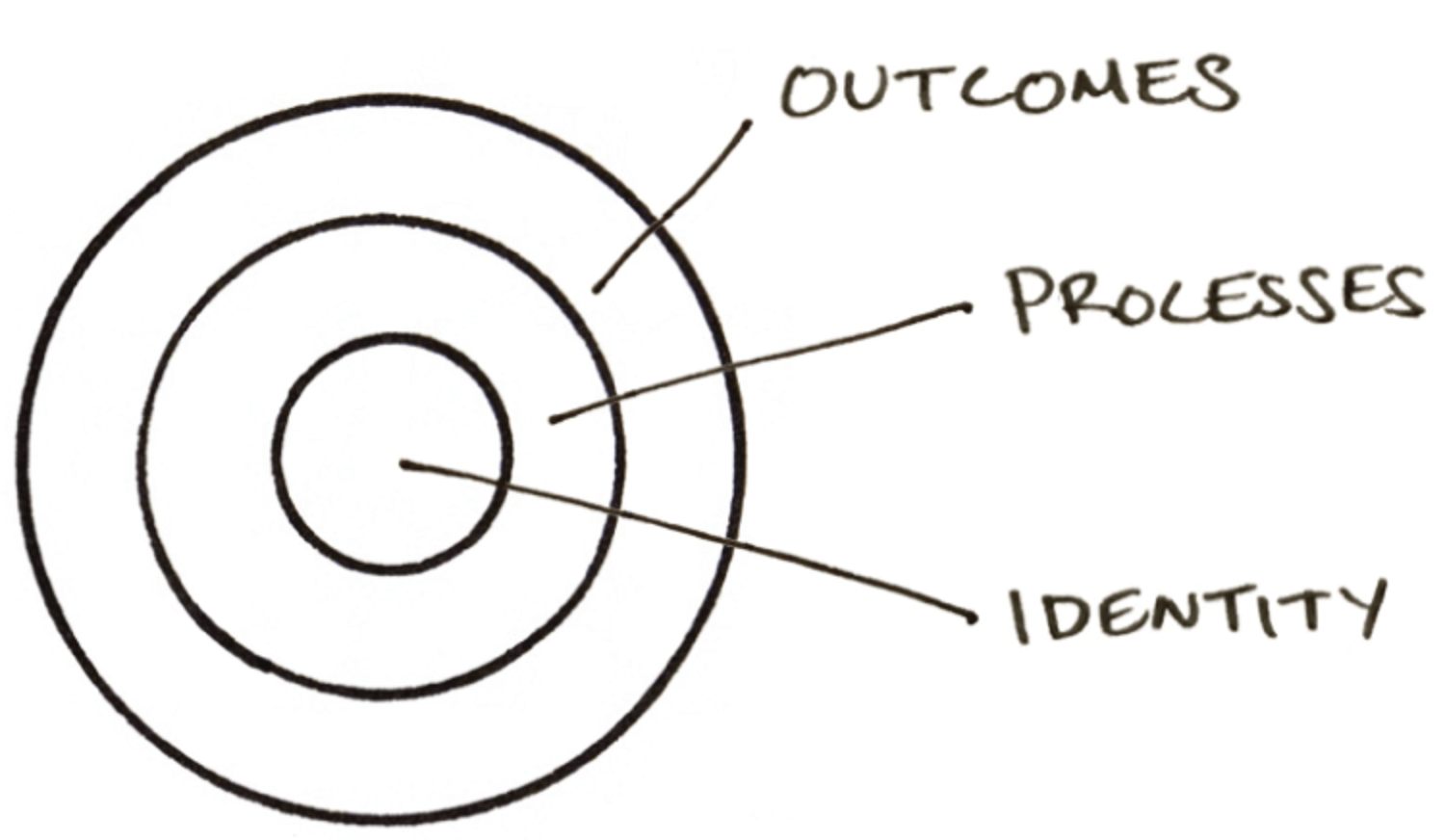
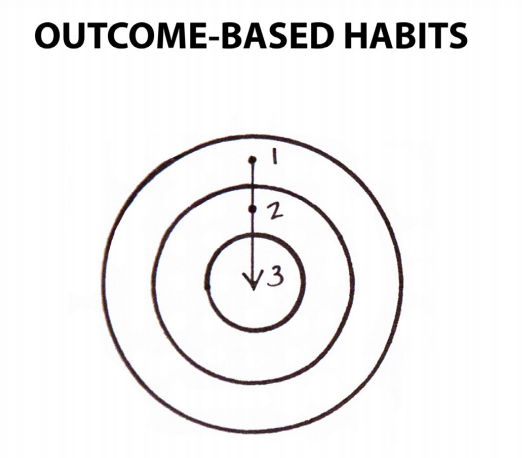
The first layer is changing your outcomes (WHAT): This level is concerned with changing your results: losing weight, publishing a book, winning a championship. Most of the goals you set are associated with this level of change.
The second layer is changing your process (HOW): This level is concerned with changing your habits and systems: implementing a new routine at the gym, decluttering your desk for better workflow, developing a meditation practice. Most of the habits you build are associated with this level.
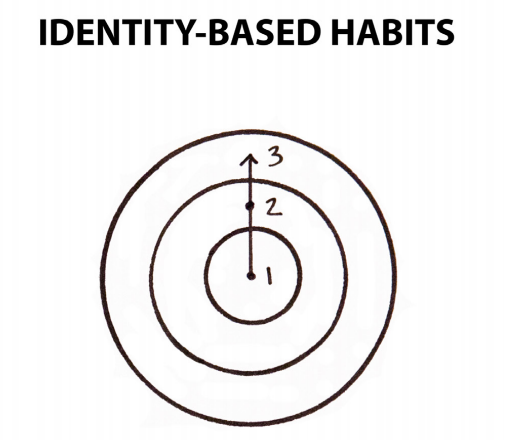
The third and deepest layer is changing your identity (WHY): This level is concerned with changing your beliefs: your worldview, your self-image, your judgments about yourself and others. Most of the beliefs, assumptions, and biases you hold are associated with this level.
Outcomes are about what you get. Processes are about what you do. Identity is about what you believe. Many people begin the process of changing their habits by focusing on what they want to achieve. This leads us to outcome-based habits. The alternative is to build identity-based habits. With this approach, we start by focusing on who we wish to become.
Why Habits Are Important?
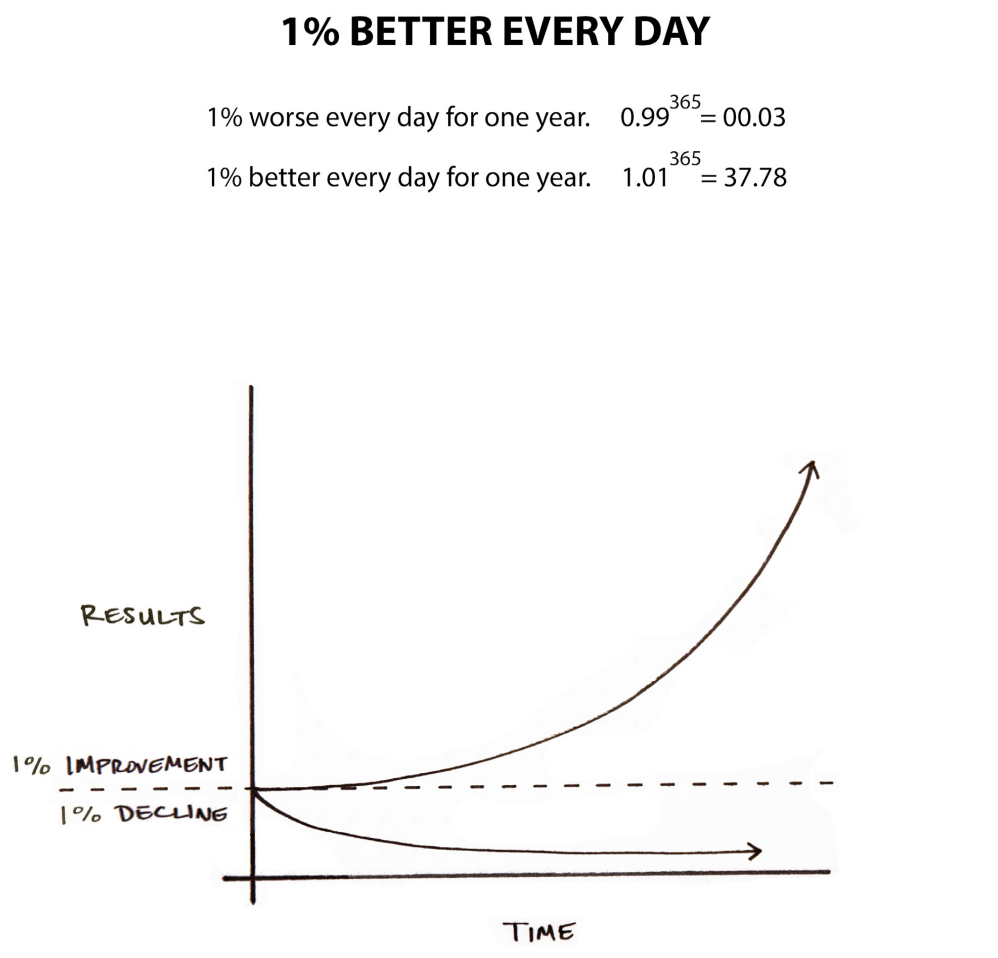
It’s important for getting 1% better everyday, don’t get discouraged by the valley of disappointment.
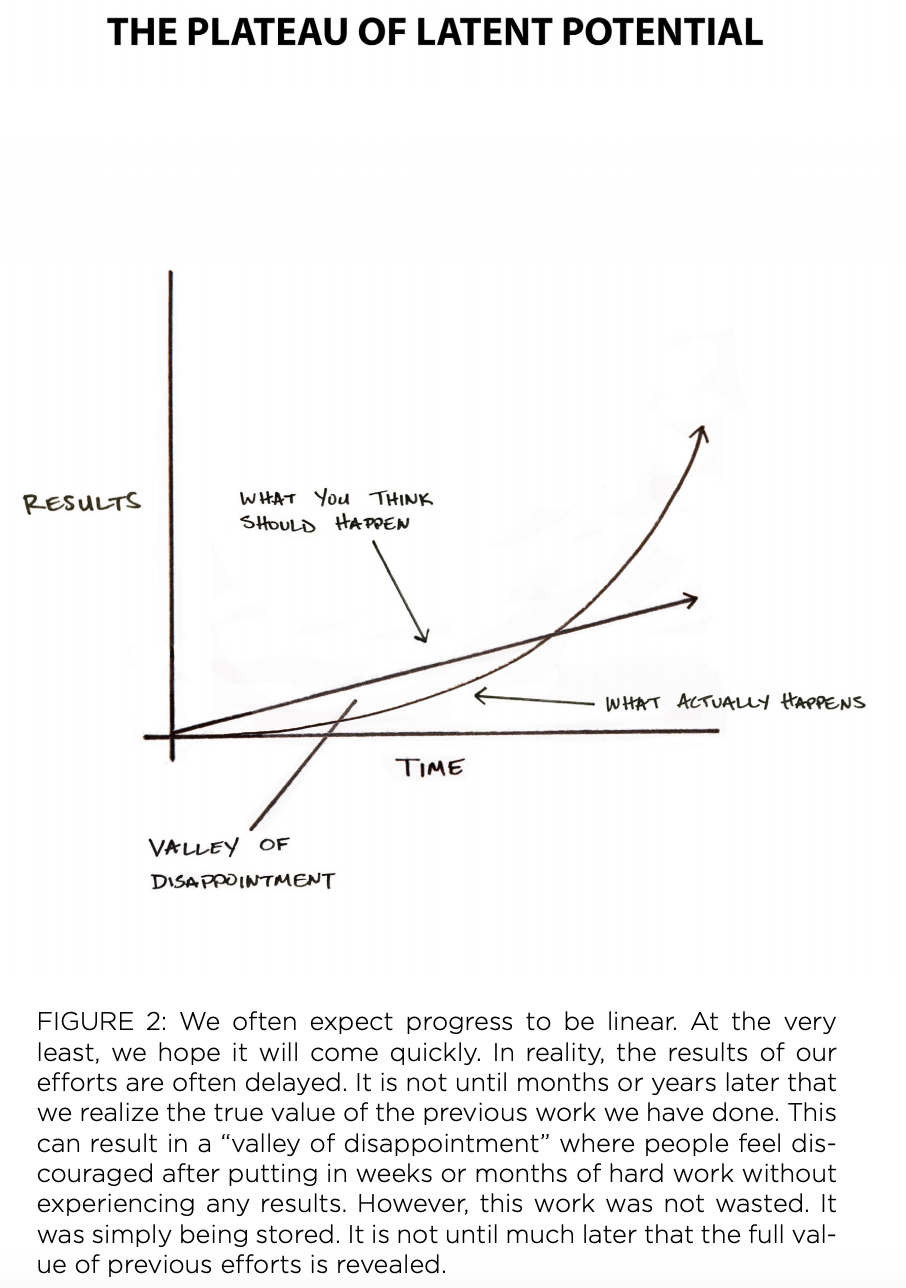
It’s important for deliberate practice.
The Framework of Habits
Summary: the most important concepts to remember here are:
- The framework of habits: cue → craving → response → reward
- The four laws of behavior change
The Anatomy of Habits
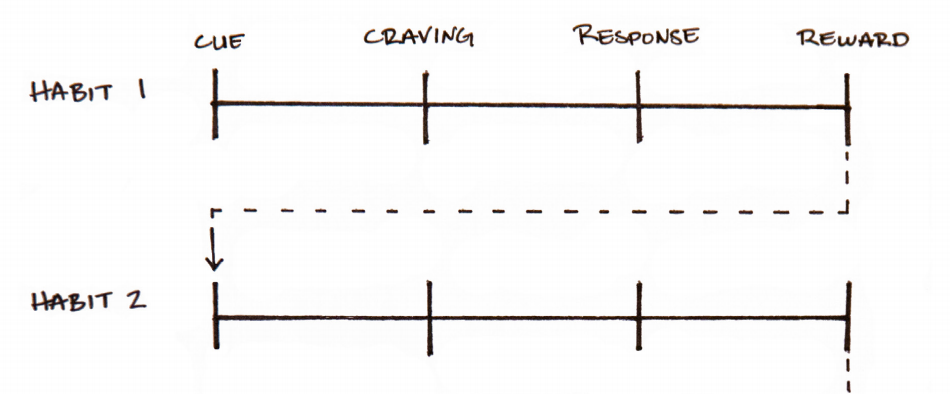
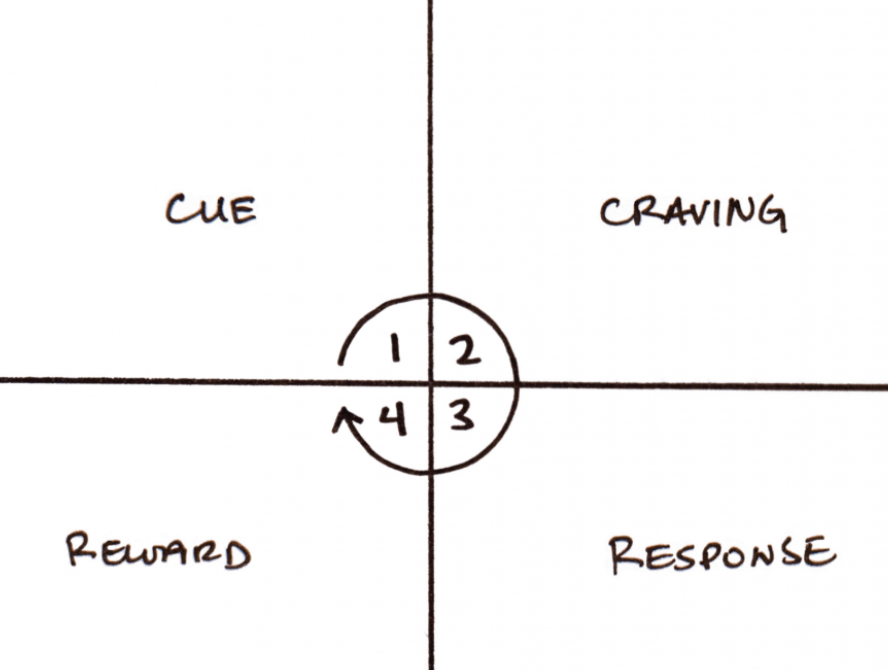 The cue triggers a craving, which motivates a response, which provides a reward, which satisfies the craving and, ultimately, becomes associated with the cue. Together, these four steps form a neurological feedback loop—cue, craving, response, reward; cue, craving, response, reward—that ultimately allows you to create automatic habits.
Cue
First, there is the cue. The cue triggers your brain to initiate a behavior. It is a bit of information that predicts a reward. Your mind is continuously analyzing your internal and external environment for hints of where rewards are located. Because the cue is the first indication that we’re close to a reward, it naturally leads to a craving.
Craving
Cravings are the second step of the habit loop, and they are the motivational force behind every habit. Without some level of motivation or desire—without craving a change—we have no reason to act. What you crave is not the habit itself but the change in state it delivers. Cues are meaningless until they are interpreted. The thoughts, feelings, and emotions of the observer are what transform a cue into a craving.
Response
The third step is the response. The response is the actual habit you perform, which can take the form of a thought or an action. Whether a response occurs depends on how motivated you are and how much friction is associated with the behavior. If a particular action requires more physical or mental effort than you are willing to expend, then you won’t do it. Your response also depends on your ability. It sounds simple, but a habit can occur only if you are capable of doing it.
Reward
Finally, the response delivers a reward. Rewards are the end goal of every habit. Rewards deliver contentment and relief from craving. Rewards teach us which actions are worth remembering in the future. Your brain is a reward detector. As you go about your life, your sensory nervous system is continuously monitoring which actions satisfy your desires and deliver pleasure. Feelings of pleasure and disappointment are part of the feedback mechanism that helps your brain distinguish useful actions from useless ones. Rewards close the feedback loop and complete the habit cycle.
The Biology of Habit Loops
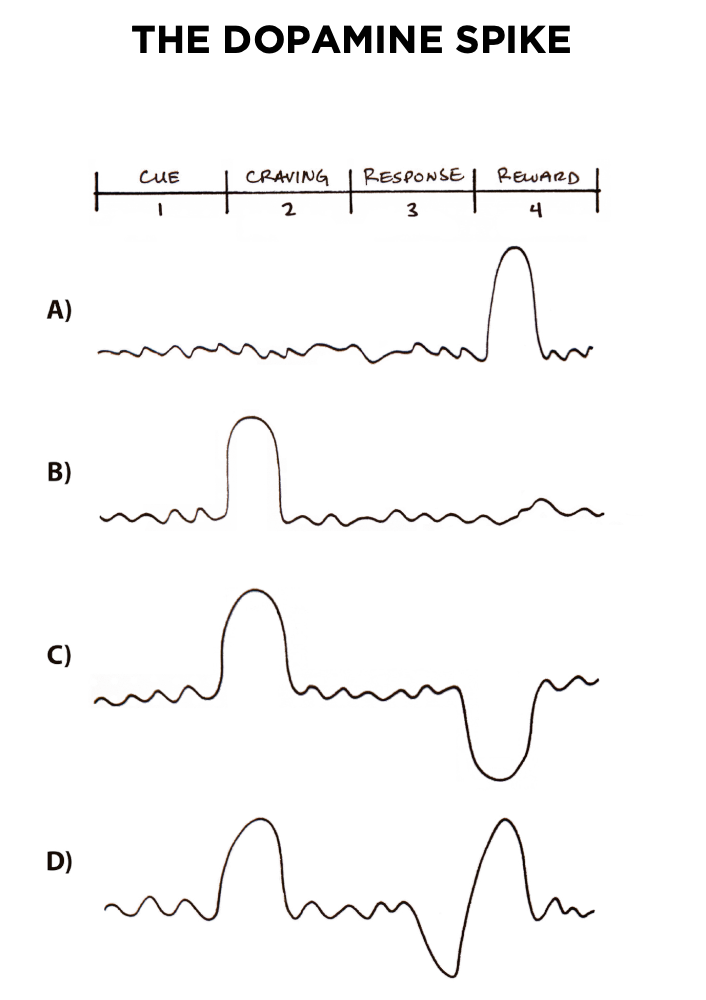
Before a habit is learned (A), dopamine is released when the reward is experienced for the first time. The next time around (B), dopamine rises before taking action, immediately after a cue is recognized. This spike leads to a feeling of desire and a craving to take action whenever the cue is spotted. Once a habit is learned, dopamine will not rise when a reward is experienced because you already expect the reward. However, if you see a cue and expect a reward, but do not get one, then dopamine will drop in disappointment (C). The sensitivity of the dopamine response can clearly be seen when a reward is provided late (D).
First, the cue is identified and dopamine rises as a craving builds. Next, a response is taken but the reward does not come as quickly as expected and dopamine begins to drop. Finally, when the reward comes a little later than you had hoped, dopamine spikes again. It is as if the brain is saying, “See! I knew I was right. Don’t forget to repeat this action next time.”
Four Laws of Behavior Change
The cue is about noticing the reward. The craving is about wanting the reward. The response is about obtaining the reward. We chase rewards because they serve two purposes: (1) they satisfy us and (2) they teach us. If a behavior is insufficient in any of the four stages, it will not become a habit.
Eliminate the cue and your habit will never start. Reduce the craving and you won’t experience enough motivation to act. Make the behavior difficult and you won’t be able to do it. And if the reward fails to satisfy your desire, then you’ll have no reason to do it again in the future. Without the first three steps, a behavior will not occur. Without all four, a behavior will not be repeated.
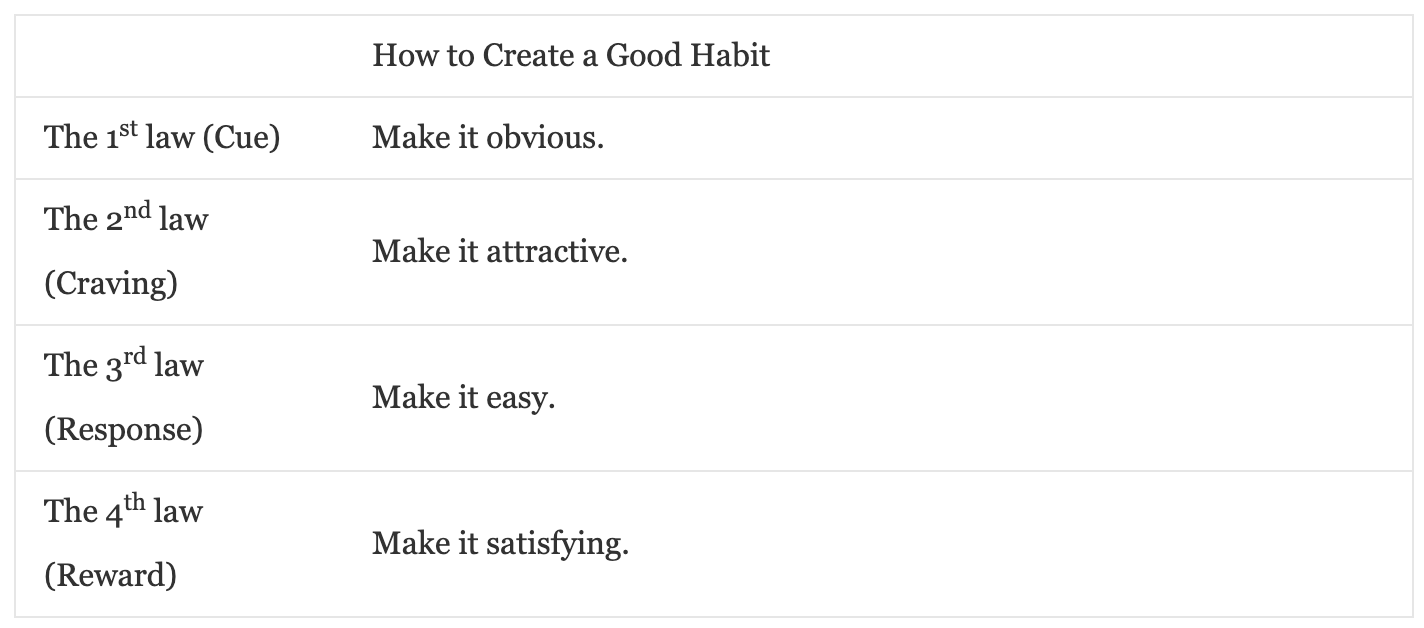
How to Create Good Habits
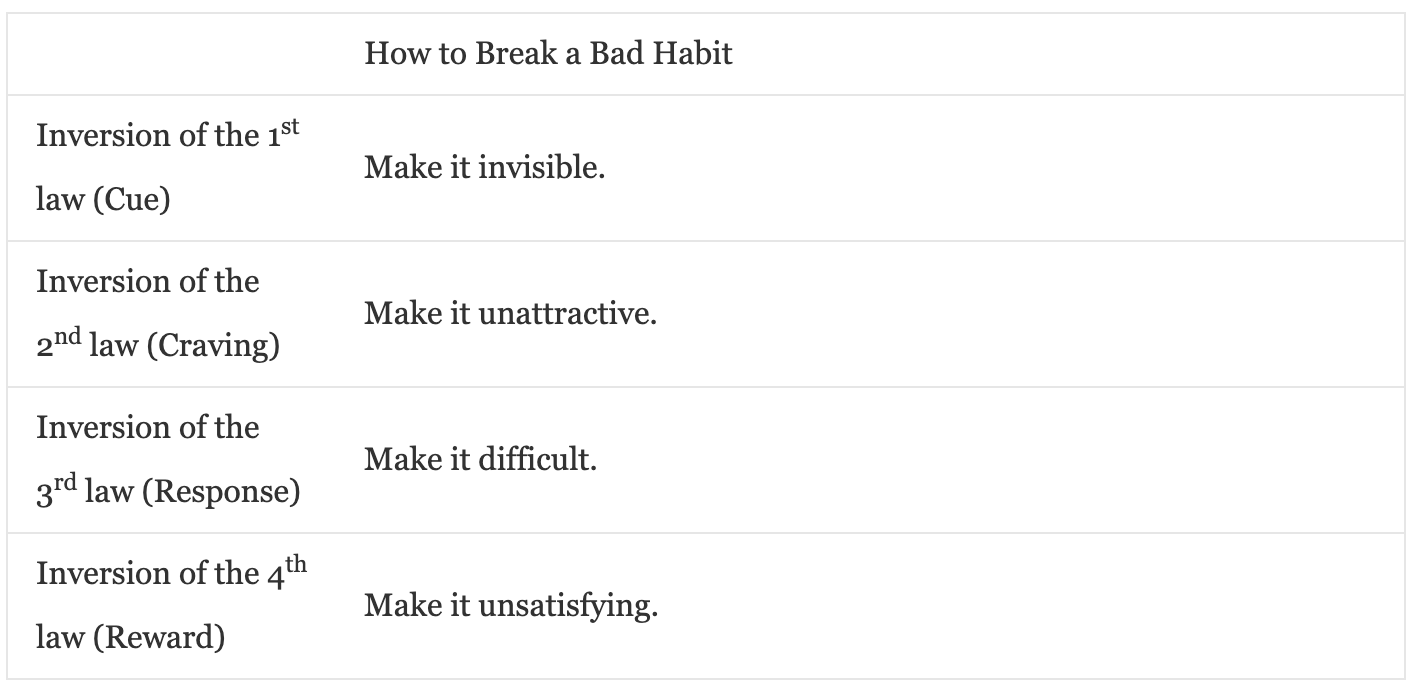
How to Break a Bad Habit
If I Only Have Time For One Habit, What Is the Best Habit to Pick?
If you’re going to stay focused on one habit to start, then I suggest selecting a habit that also ripples into other areas of your life. Charles Duhigg, author of The Power of Habit, refers to these behaviors as “keystone habits.” For example, exercise is my keystone habit. When I work out, I not only get the benefits of exercise, but I also tend to sleep better, focus longer, and eat healthier—even though I don’t consciously focus on these things. Exercise is the one habit that pulls the rest of my life in line.
Of course, finding the “best” habit also depends on the person. This is partially because people often have different goals, but also because the right habit depends on your personality and disposition. People can get ripped working out like a bodybuilder, but if you prefer rock climbing or cycling or rowing, then shape your exercise habit around your interests. Choose the habit that best suits you, not the one that is most popular.
Case Study 1: How to Form a Good Habit
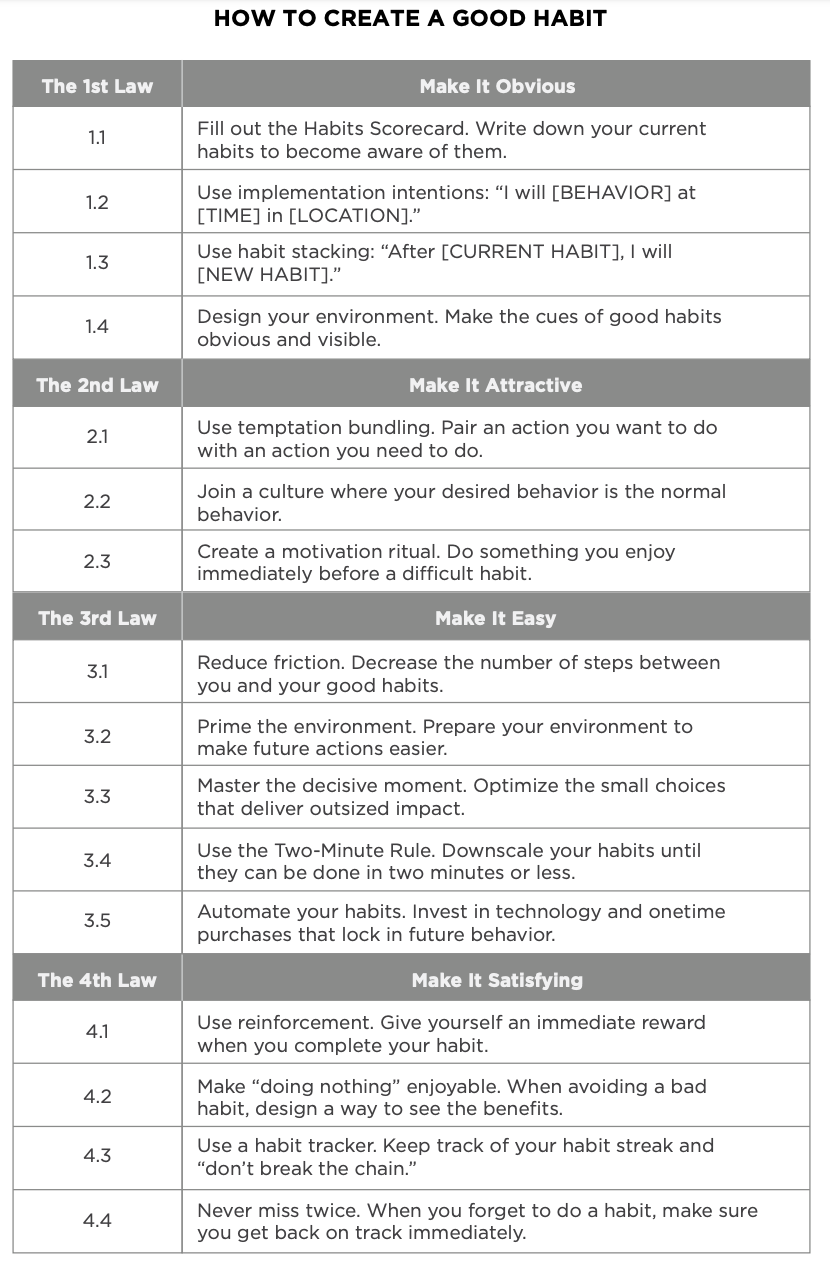
To create a good habit, follow the 4 laws of behavior change - Make it obvious (add more cues), make it attractive (increase craving), make it easy (make response easier), and make it satisfying (increase reward).
Overview
How Do I Know If a Habit Is Good Or Bad?
Technically speaking, habits aren’t “good” or “bad.” It might be better to call them “effective” or “ineffective.” If a habit effectively solves the problem you’re facing, then you’ll have a reason to repeat it. All habits serve you in some way—even the bad ones—which is why you do them. Biting your nails might ease your stress or anxiety, for example.
However, people still use the terms “good habit” and “bad habit” all the time, and I think there is a simple way to distinguish between the two. Whether a habit is good or bad usually depends on the long-term benefits or consequences of the behavior. Generally speaking, good habits will have net positive outcomes in the long-run. Bad habits have net negative outcomes.
Smoking a cigarette may reduce stress right now, but it’s not a healthy long‐term behavior. It might be effective in the short-run, but it tends to be harmful over time. The longer you expand the time scale, the more clearly you can notice the differences between good and bad habits.
The First Law - Make It Obvious
Paper clip strategy :: Visual cues remind you to start a behavior: We often lie to ourselves about our ability to remember to perform a new habit. (“I’m going to start eating healthier. For real this time.”) A few days later, however, the motivation fades and the busyness of life begins to take over again. Hoping you will simply remember to do a new habit is usually a recipe for failure. This is why a visual stimulus, like a bin full of paper clips, can be so useful. It is much easier to stick with good habits when your environment nudges you in the right direction.
Paper clip strategy :: Visual cues can have an additive effect on motivation: As the visual evidence of your progress mounts, it is natural to become more motivated to continue the habit. The more paper clips you place in the bin, the more motivated you will become to finish the task. There are a variety of popular behavioral economics studies that refer to this as the Endowed Progress Effect, which essentially says we place more value on things once we have them. In other words, the more paper clips you move to the “Completed” bin, the more valuable completing the habit becomes to you.
Implementation Intention: People who make a specific plan for when and where they will perform a new habit are more likely to follow through. The simple way to apply this strategy to your habits is to fill out this sentence: I will [BEHAVIOR] at [TIME] in [LOCATION].
Habit Stacking: Introduced by Stanford Professor BJ Fogg, the key idea is to “stack” your new habit on top of a current habit. That is, your current behavior becomes the cue for your new behavior. “After [CURRENT HABIT], I will [NEW HABIT].”
Pre-game Rituals: Use pre-game routines to pull them into the right mental state, regardless of how they feel. You can use this same process to overcome your motivation threshold and consistently exercise, study, write, speak, or perform any other task that is important to you.
- A good pre–game routine starts by being so easy that you can’t say no to it. You shouldn’t need motivation to start your pre–game routine.
- Your routine should get you moving towards the end goal.
- You need to follow the same pattern every single time.
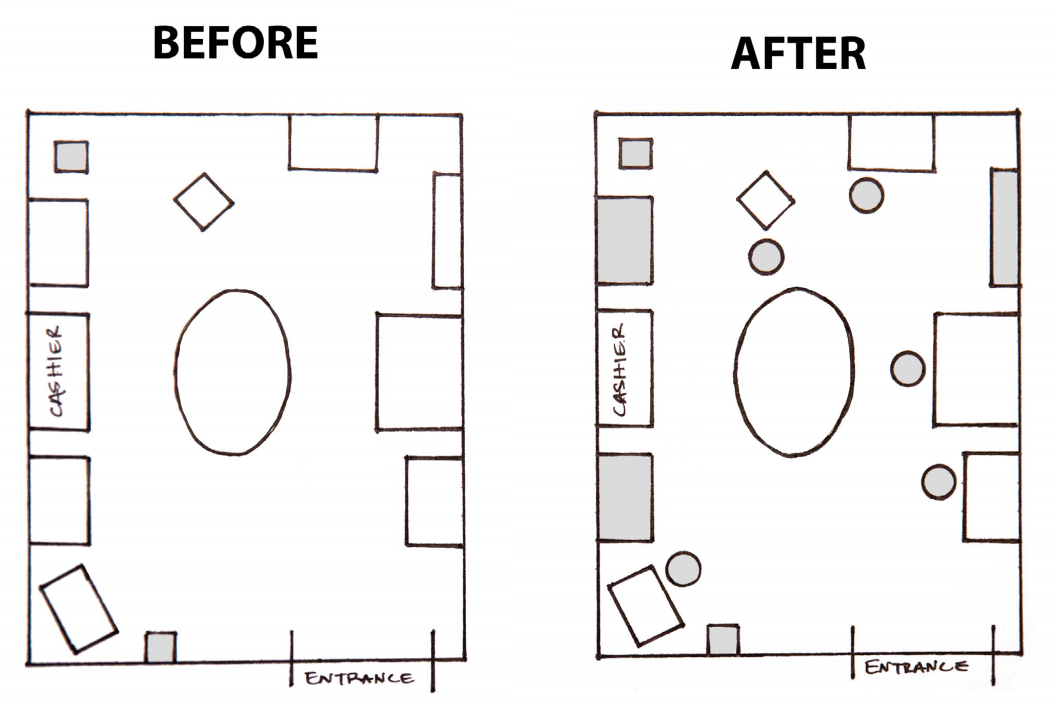
Designing your Environment: Physical environment is one of the most overlooked drivers of habits and behavior change. Your habits are often triggered by what is obvious or available to you in your current environment. If you want to make a habit a big part of your life, make the cue a big part of your environment. By sprinkling triggers throughout your surroundings, you increase the odds that you’ll think about your habit throughout the day. Making a better decision is easier when the cues for good habits are right in front of you. Don’t rely on willpower and self-control.
The Second Law - Make It Attractive
Temptation Bundling: This is based on the principle that “more probable behaviors will reinforce less probable behaviors.” If you can find something you already want to do and connect it with the habit that you need to do, you’ll be more likely to complete the habit. To put it another way: You’re more likely to find a behavior attractive if you get to do one of your favorite things at the same time.
Join forces with somebody: pair up with someone and quit together. The two of you can hold each other accountable and celebrate your victories together. Knowing that someone else expects you to be better is a powerful motivator. Surround yourself with people who live the way you want to live. You don’t need to ditch your old friends, but don’t underestimate the power of finding some new ones. This is the part about craving. We are social animals, so working on it with others makes it more attractive.
Social norms are a powerful driver of our everyday behavior. If you find yourself in a social situation where your desired habit goes against the grain of the group, then it will be hard to stick with it because doing so seems unattractive. The best option is to join a culture where:
- your desired behavior is the normal behavior, and
- you already have something in common with the group
The Third Law - Make It Easy
Start Super Small: You want to take on the smallest possible behavior that gets you moving in the right direction. The most effective way I know to counteract this tendency is to use the Two-Minute Rule, which states, “When you start a new habit, it should take less than two minutes to do.”
Plan for Chaos :: Reduce the Scope, Stick to the Schedule: The basic idea is that on any given day it is more important to stick to your schedule than it is to meet your expectations. For example, my expectation is to write a useful article every Monday and Thursday. But it’s more important that I stick to the schedule and maintain my habit for the long-term than it is for every post to be incredible. This is related to making the response easier, and making sure that the smaller reward is still associated with the craving (so to keep the train of habit going).
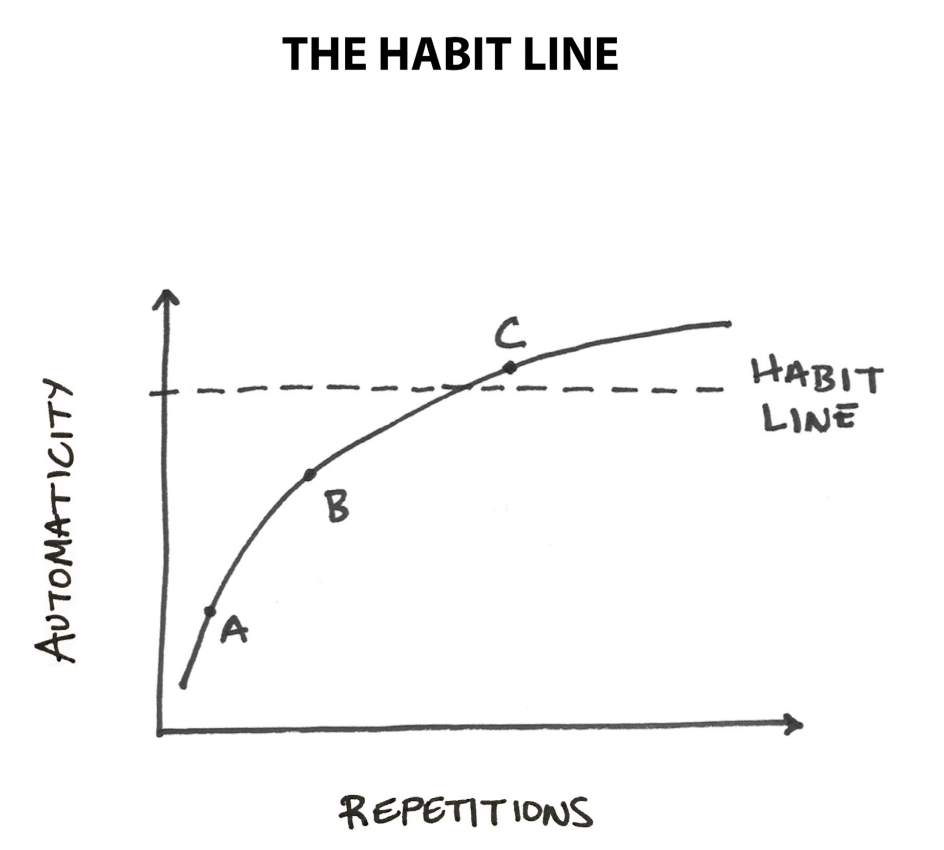
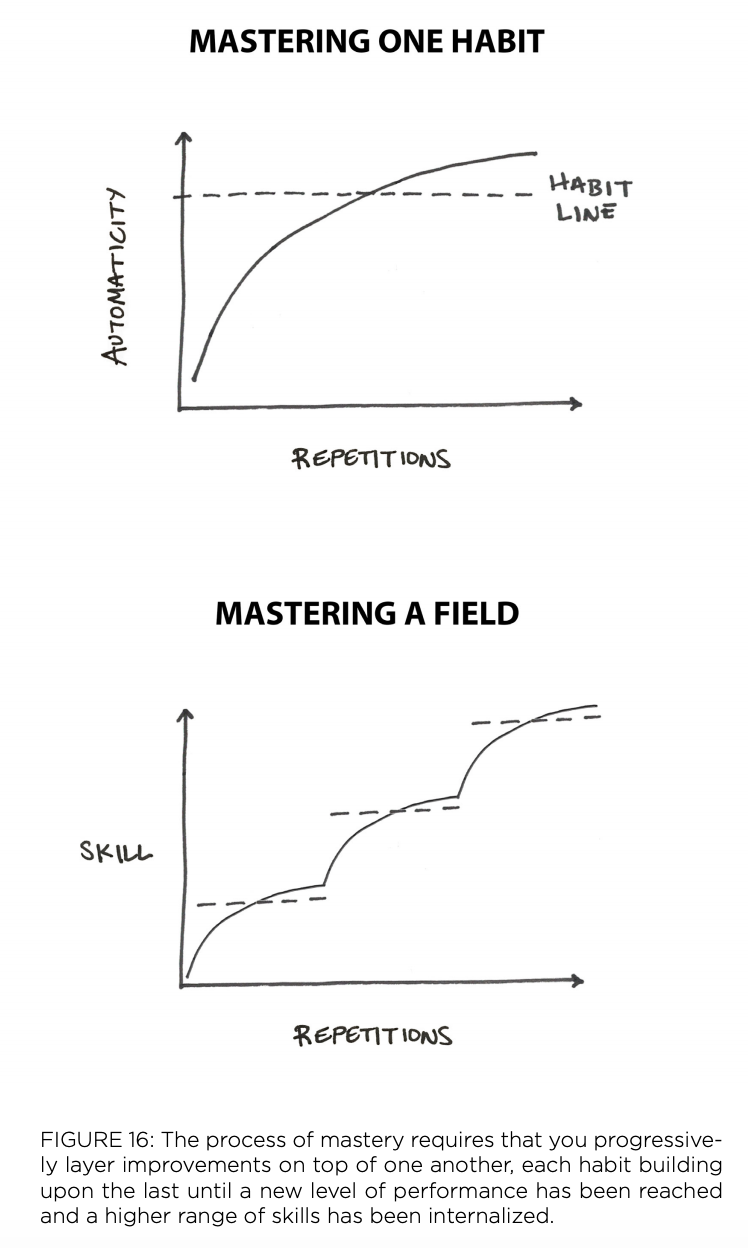
In the beginning (point A), a habit requires a good deal of effort and concentration to perform. After a few repetitions (point B), it gets easier, but still requires some conscious attention. With enough practice (point C), the habit becomes more automatic than conscious. Beyond this threshold— the habit line — the behavior can be done more or less without thinking. A new habit has been formed.
Commitment Device: If you find yourself falling into an unwanted habit again and again, one of the most effective strategies is to create a commitment device. A commitment device is a choice you make in the present that controls your actions in the future. It is a way to lock in future behavior, bind you to good habits, and restrict you from bad ones. Commitment devices are useful because they enable you to take advantage of good intentions before you can fall victim to temptation.
Plan for Chaos :: The If-Then Technique: The If-Then Technique is the perfect way to plan for chaos and stick to your goals even when life gets crazy. Why? Because it forces you to create a strategy for reducing the scope, but sticking to the schedule before you actually need to do so. All you need to do is complete this phrase: “If [something unexpected], then [your response].”
- If I don’t wake up in time to run tomorrow morning, then I’ll run after work.
- If I can’t make it to yoga during my lunch break, then I’ll take a stretching break this afternoon.
- If I buy something unhealthy for lunch, then I’ll cook a healthy meal for dinner.
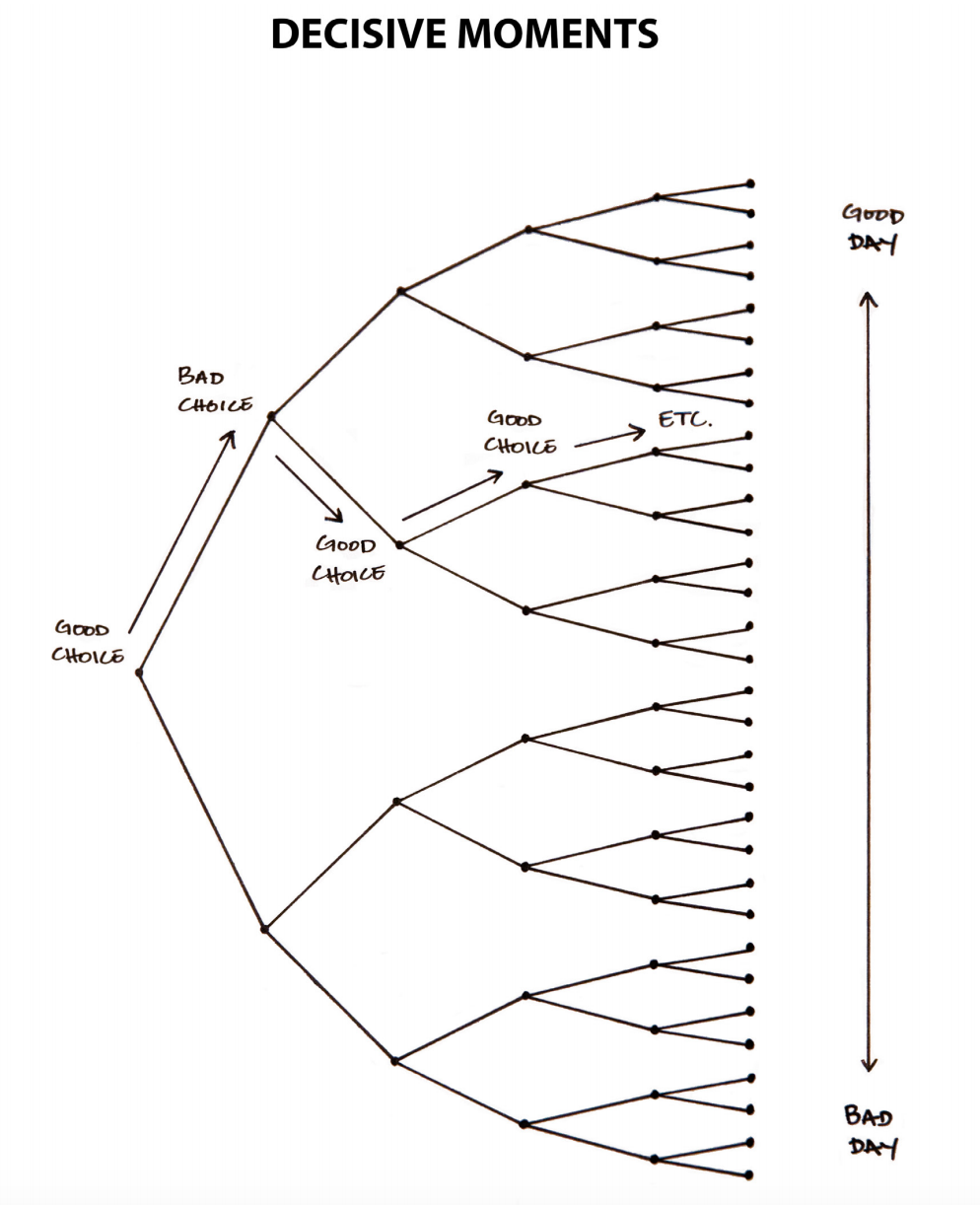
Use the Bright-line rule: A bright-line rule refers to a clearly defined rule or standard. It is a rule with clear interpretation and very little wiggle room. It establishes a bright line for what the rule is saying and what it is not saying. e.g. I only process email between 11AM and 6PM. / I enjoy a maximum of 2 drinks per night / I save $500 per month for retirement … etc.
First, bright lines shift the conversation in your head from one of sacrifice to one of empowerment. When you don’t have a bright line established and you choose not to do something, the tendency is to say, “Oh, I can’t do it this time.” Conversely, when you do have a bright line clearly set, your response can simply be, “No thanks, I don’t do that.” Bright lines help you avoid making just-this-once exceptions. Instead, you are following a new identity that you have created for yourself.
Second, by establishing clear decisions in your life, you conserve willpower for other important choices. Here’s the problem with trying to make daily decisions in muddy water: Without bright lines, you must decide whether a situation fits your standards every time. With bright lines, the decision is made ahead of time. Because of this, you are less likely to suffer from decision fatigue and more likely to have willpower left over for work, relationships, and other health habits.
Search for point of friction and eliminate them: The central idea is to create an environment where doing the right thing is as easy as possible and the unproductive thing is as difficult as possible. e.g. Sign up for a gym that’s physically on the way to / from work (rather than out of the way).
The Fourth Law - Make It Satisfying
Paper clip strategy :: Visual cues display your progress on a behavior: Everyone knows consistency is an essential component of success, but few people actually measure how consistent they are in real life. The Paper Clip Strategy avoids that pitfall because it is a built-in measuring system. One look at your paper clips and you immediately have a measure of your progress.
Paper clip strategy :: Visual cues can be used to drive short-term and long-term motivation: The Paper Clip Strategy can provide daily motivation, but you start from scratch each day. However, another type of visual cue, like the “Don’t Break the Chain” Calendar that I described in my article on the Seinfeld Strategy can be used to showcase your consistency over longer periods of time. By stacking these two methods together, you can create a set of visual cues that motivate and measure your habits over the short-run and the long-run.
Never Miss Twice: The first mistake is never the one that ruins you. It is the spiral of repeated mistakes that follows. Never miss twice. Never miss twice gives you some flexibility (you don’t have to be perfect), but it also holds you accountable (don’t repeat the same mistake twice). It’s also an identity reinforcer - if you insist on doing something important for you, that becomes a part of you.
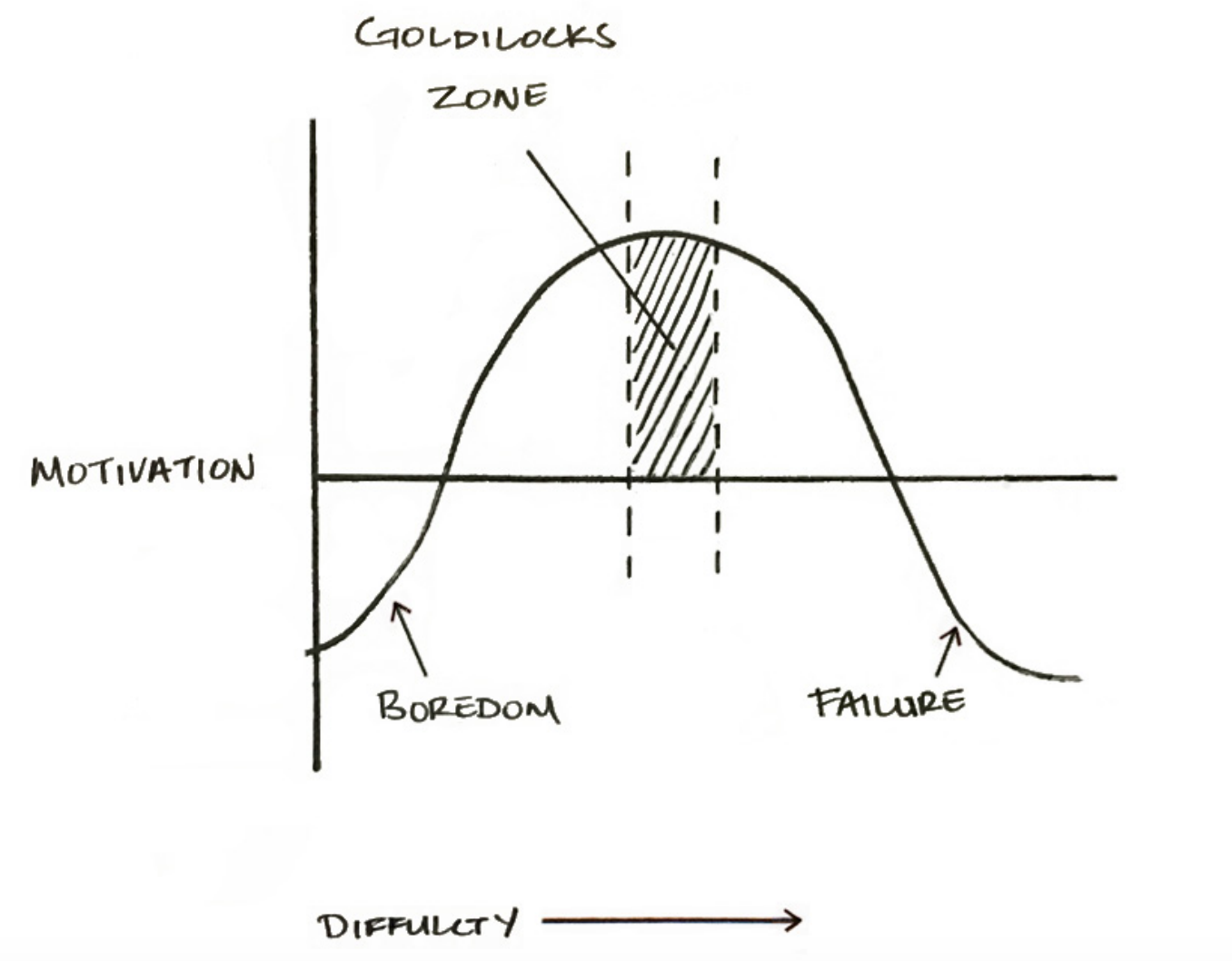
Adhere to Goldilocks Rule: The Goldilocks Rule states that humans achieve peak motivation when working on tasks of “just manageable difficulty.” However, there is a second point to add here. One of the most motivating feelings is the feeling of progress. But the key is that you need to be able to visualize your progress for it to be motivating. If you don’t have any way of noticing that you’re moving forward, then it’s easy to lose motivation. This is where visual measures of progress like the Paper Clip Strategy or Habit Tracking come into play.
Habit Contract: Staying disciplined can be hard, which is why it can be helpful to enlist the support of someone else. A simple way to do this is by creating a habit contract, which is a written agreement in which you state your commitment to a particular habit and the punishment that will occur if you don’t follow through. Declaring your goals publicly also has this effect, people generally find it unattractive to be shamed publicly.
Case Study 2: How to Break a Bad Habit
Summary: Bad habits address certain needs in your life. And for that reason, it’s better to replace your bad habits with a healthier behavior that addresses that same need. If you expect yourself to simply cut out bad habits without replacing them, then you’ll have certain needs that will be unmet and it’s going to be hard to stick to a routine of “just don’t do it” for very long.
Overview
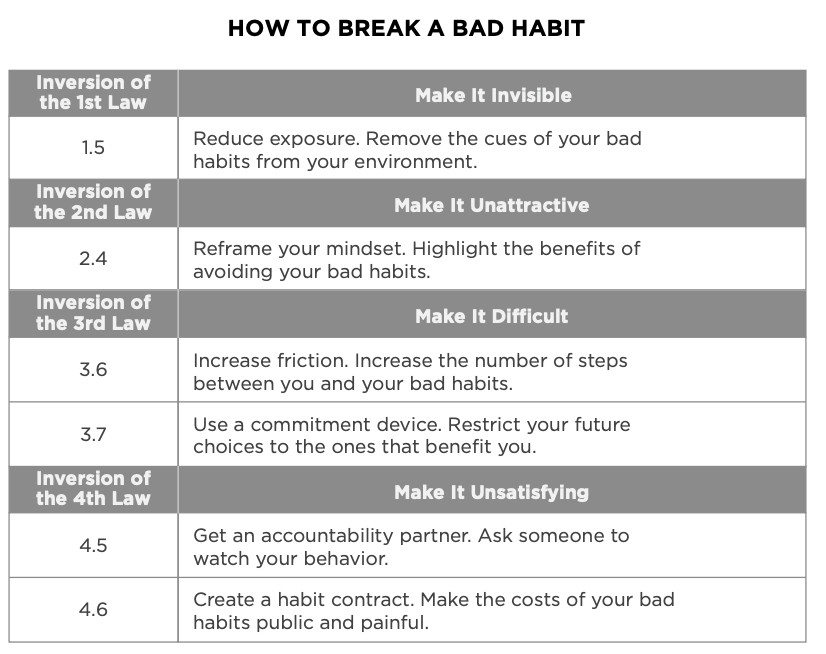
Cause of Bad Habits: Stress & Boredom
Most of your bad habits are caused by two things - Stress and boredom. Most of the time, bad habits are simply a way of dealing with stress and boredom. Everything from biting your nails to overspending on a shopping spree to drinking every weekend to wasting time on the internet can be a simple response to stress and boredom.
Inversion of First Law - Make It Invisible
Cut out as many triggers as possible: If you smoke when you drink, then don’t go to the bar. If you eat cookies when they are in the house, then throw them all away. If the first thing you do when you sit on the couch is pick up the TV remote, then hide the remote in a closet in a different room. Make it easier on yourself to break bad habits by avoiding the things that cause them. This is the part where you eliminate cues or make it invisible.
When scientists analyze people who appear to have tremendous self-control, it turns out those individuals aren’t all that different from those who are struggling. Instead, “disciplined” people are better at structuring their lives in a way that does not require heroic willpower and self-control. In other words, they spend less time in tempting situations. The people with the best self-control are typically the ones who need to use it the least. It’s easier to practice self-restraint when you don’t have to use it very often. So, yes, perseverance, grit, and willpower are essential to success, but the way to improve these qualities is not by wishing you were a more disciplined person, but by creating a more disciplined environment.
A more reliable approach is to cut bad habits off at the source. One of the most practical ways to eliminate a bad habit is to reduce exposure to the cue that causes it. Self-control is a short-term strategy, not a long-term one. You may be able to resist temptation once or twice, but it’s unlikely you can muster the willpower to override your desires every time. Instead of summoning a new dose of willpower whenever you want to do the right thing, your energy would be better spent optimizing your environment. This is the secret to self-control. Make the cues of your good habits obvious and the cues of your bad habits invisible.
Keep track of your bad habits: Pick up a couple sets of notecards and spend about a week recording “who,” “what,” “when,” and “where” for your bad habits. Analyze what are the triggers that start your bad habits.
Inversion of Second Law - Make It Unattractive
Choose a substitute for your bad habit: You need to have a plan ahead of time for how you will respond when you face the stress or boredom that prompts your bad habit. What are you going to do when you get the urge to smoke? (Example: breathing exercises instead.) What are you going to do when Facebook is calling to you to procrastinate? (Example: write one sentence for work.) Whatever it is and whatever you’re dealing with, you need to have a plan for what you will do instead of your bad habit. This is the part where you re-program yourself to use a different, healthier response to a craving to get the same reward.
Inversion of Third Law - Make It Difficult
See “how to develop a good habit” and invert them
Inversion of starting-small (Reducing the scope): Write down a bad habit that you’d like to break, then come up with at least 3 different divisions for how you can move that habit forward.
- Bad Habit: ____________
- Division 1: This little rule should be incredibly easy to keep
- Division 2: A bit more improvement from Division 1
- Division 3: A bit more improvement from Division 2
Inversion of Fourth Law - Make It Unsatisfying
See “how to develop a good habit” and invert them